Arrow Games

















Reviews of arrow games and tools on Arrow Games — gameplay, difficulty, similar genres, and which titles are worth your time.
Arrow Game Reviews
This is where we write up the games and tools on Arrow Games — enough detail to help you decide what to open next.
Most of what we cover sits under the arrow theme: directional puzzles, maze escapes, clear-the-board boards, archery action, and browser tools that use arrows as pointers or pickers.
What we review
Games. The repeating rule, how difficulty grows, when a level feels fair or unfair, and whether the controls stay readable when the board gets busy. For titles on this site, the write-up follows the playable version.
Tools. A spinner, a direction picker, a route helper: whether the purpose is obvious, the result makes sense, and the extras (text, images, customization) are worth keeping. The Arrow Spinner is a clear example — direction, text, and image modes treated as something you would open again for a real use.
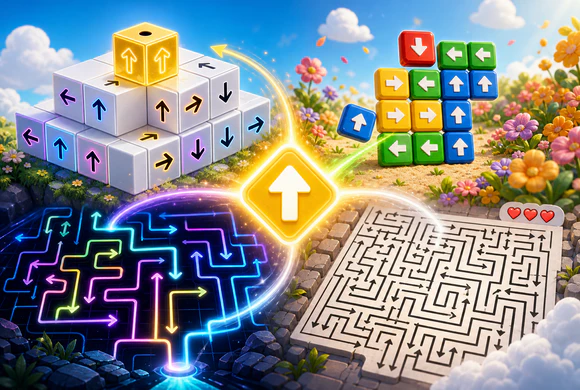
Comparisons show up often. When several games share an arrow look but ask for different skills, we put them side by side. Our four-game arrow puzzle comparison covers flat clearing, move budgets, 3D stacks, and maze routes, and what each one rewards.
How we position a game
Before calling something good or weak, we pin down what it is trying to be. A calm sequence puzzle and an action shooter need different standards; a move-limited clearer is more than its screenshot.
A few practical checks:
- Win condition — empty the board, escape the maze, hit the target, or something else.
- Pressure — limited moves, hearts, a timer, pure sequencing, or none of those.
- Skill in a good run — order recognition, spatial reading, route planning, aim, or reaction.
- Fit — a quiet five minutes, or someone who likes optimizing every tap.
Two games can both say "arrow puzzle" and still belong in different conversations. The review lines up with the game's own goal, then notes where it holds up and where it doesn't.
How we place genre and type
Type comes from play, not from the name on the icon. A title with "escape," "arrow," or "shoot" in the label can still land somewhere else once you see what the player does — solving a board, dodging and getting out, aiming under pressure, or reacting in real time.
| What you mostly do in play | Type we use in the review | Why it lands there |
|---|---|---|
| Read blockers, removal order, or limited moves | Puzzle | The win comes from logic and sequence |
| Trace a route, leave a maze, or clear a jammed path | Escape / maze | Progress is about finding a way out |
| Dodge hazards, survive waves, or keep moving under threat | Action / avoid | Timing and reaction carry the session |
| Aim, draw, or release a shot at targets or enemies | Shooting / archery | The arrow is a projectile; the loop is aim and fire |
| Rotate stacks, read hidden faces, or reason in depth | Spatial puzzle | Still puzzle, but the skill is 3D reading |
| Pick a direction or random result for a practical use | Tool | Treated as a utility |
So a title that mixes “arrow” with “escape” in its name does not automatically make a game escape. If the loop is tapping pieces off a grid in the right order, we call it puzzle. If the arrow is something you aim and fire, we treat it as shooting or light action, even when another listing files it under puzzle.
Site tags — puzzle, escape, arcade, shooting, and the rest — follow that reading. When a title mixes types, the review says which mode is which. Comparisons group or contrast games by shared play.
What a review usually covers
- The loop: what you tap, swipe, or drag; what counts as success; what a mistake costs.
- Presentation vs. play: whether the arrows stay readable, and whether extra modes change the base rule or only decorate it.
- Assists and limits: hints, zoom, bombs, shuffle, hearts, move counters — and how they affect the session.
- Where it feels strong, and where it gets awkward (dense boards, unclear depth, harsh failure).
- A concrete recommendation: who it suits, rather than a single overall winner.
Why comparisons show up
One write-up can explain a single game. A comparison makes the differences easier to see: why one board feels calm and another feels strict, why one title is a maze and another is a dismantle puzzle.
We keep the axes simple — objective, board style, pressure, assists, and the skill each game rewards — and link to playable examples on Arrow Games when we can. That is how the Arrow Eliminate / Tap Away Arrow / Arrow Out Online / Arrows Go piece is set up: matching each game to a different way of solving. Individual reviews may mention a nearby title when it helps place the feel.
Arrow gameplay, and what it feels like
"Arrow game" is a loose label. The arrow can be a blocker on a grid, a path through a maze, a cube face you rotate into view, or a shot you draw and release. The play styles we see most often:
- Clear-the-board / arrow out. Tap or fire pieces off the grid in the right order. Close to untangle and traffic-clearing puzzles: one wrong sequence and the last few pieces trap each other.
- Maze navigation. Read a chain of directions and find a safe route out. Same family as classic maze and escape pathing — slower, more about tracing ahead than emptying the board.
- 3D spatial boards. Arrows on stacked or rotatable cubes; what looks blocked from one angle may be free from another. Closer to Rubik-style spatial puzzles than to flat match-and-clear games.
- Path untangling / traffic control. Long tails, vehicles, or routes that must leave without crossing. Related to rush-hour and path-unravel puzzles.
- Archery and trajectory. Aim, draw, or bend a shot. Closer to shooting and physics puzzles than to pure logic.
If you already like puzzle, escape, or casual brain games, a lot of this will feel familiar. The arrow theme is another way of asking for order, spatial reading, route planning, and sometimes timing.
How to use these reviews
Skim for the play loop and the pressure (moves, hearts, timer, or pure sequence). A calm flat clearer and a rotatable 3D stack can share an "arrow puzzle" tag and still feel nothing alike.
Prefer short, low-friction sessions? Start with sequence-focused clearers. Want every tap to matter? Look for move-limited boards. Prefer mazes over dismantling piles? Go for route-finding titles. For tools, see whether the result is something you would use again.
You can try most of the games we write about free in the browser at arrowsgames.io.